Showing posts with label British books. Show all posts

Thursday, July 26, 2018

Don't Forget, Matilda
by Ronda and David Armitage


“It was a rainy sort of morning. Mother had gone to work and Father was doing the dishes.”
 
With those eighteen words, my worldview changed. Eighteen words and a picture of a dad, shown only from behind, apron around his waist, at the sink, scrubbing the dirty saucepans and plates. Mother had gone to work. Father was doing the dishes. Don’t ever underestimate the role picture books play in shaping a child’s mind. When I was a little boy, the above passage shaped mine. I’m forever thankful that it did.
 
If you haven’t heard of Don’t Forget, Matilda, don’t worry, you’re in the majority. It was written in 1978 and has long been out of print and difficult to find. There is even a copy on Ebay listed for the farcical price of $193.82. The author is Ronda Armitage, the illustrator her husband David; if you have heard of the Armitages, it’s likely because of their best-known book The Lighthouse Keeper’s Lunch, and its sequels. Don’t Forget, Matilda is, ironically, largely forgotten. But not by me.
 
I grew up in a small town in rural Victoria, where most families functioned with dad as the breadwinner and mum looking after the children. Not, to borrow a line from Jerry Seinfeld, that there’s anything wrong with that. It’s fine if that’s who you are. I had a wonderful, caring mother, who had worked as a primary teacher in her youth but stayed at home once she had kids. Dad was a dairy farmer; it was hard work but because we lived on the farm, he was always around. I saw loads more of him than many kids whose dad worked in an office. I had a terrific childhood.
 
Still, I thought I had a pretty clear view of how the world worked, no doubt moulded in part by television, books, and the examples of other families I knew. Fathers went to work in the morning and mothers looked after the kids. And then I came across Don’t Forget, Matilda, where the mother worked and the father stayed at home looking after little Matilda. And I had an epiphany. I remember it vividly. I thought to myself, if I ever have kids, I’d like to stay at home and look after them. Matilda’s father does it, maybe I could too.
 
Thirty-odd years later, at least a few days a week, I do exactly that. These days, lots of men do. There are plenty more who would if they could, but for whom it is just not a realistic option. I get that. I am acutely aware that I’m in a very fortunate employment situation. But I know also that some men (and I suspect more men than society cares to admit) would still baulk at stepping back from their careers to stay at home with the kids, while they think nothing of their wife or partner doing so. It's a sad reflection of the fact that raising the next generation, while invaluable work, remains widely undervalued.
 
It’s also a shame, because they’re missing out on one of life’s great opportunities – and so are their children. Don’t get me wrong, looking after Heidi and Fletcher is not all smiles and swings at the park. Toddlers are emotionally complex and tantrums frequent. Then there are the endless nappies, loads of washing, meals, faces and hands and tables everythings to clean. Juggling two kids aged three and under is challenging, tiring work. But it’s also priceless, hugely rewarding, and I wouldn’t change a thing. I’m sure Matilda’s father would say something similar.
 
Don’t Forget, Matilda is a day in the life of a little koala named Matilda Elizabeth Bear. Throughout her day, everyone seems to forget something. Father forgets the pushchair when they catch the bus to the shops, Grandad pretends to forget Matilda’s name when she visits for lunch, Matilda forgets to take her handkerchief and can’t stop sniffing, and Granny forgets to put Matilda’s shoes on when they go to the park. The next day, Father and Matilda miss the bus to the beach, but realise that in any case Father had forgotten to pack their lunch.
 
Mother appears only on a single page, nicely dressed, picking Matilda up from Granny’s house on the way home from work. Father seems to be the primary carer, with help from Matilda’s grandparents. That may not be especially remarkable today, but remember that this book was published in the late 1970s, when most picture books reflected a society still tethered to the traditional roles of men and women. And what strikes me now, looking back as an adult, is how normal the Armitages make the situation appear. Importantly, it is not presented as a novelty.
 
I wondered why the Armitages – Ronda is a New Zealander and David from Tasmania, though they have lived in England since the 1970s – chose to make Matilda’s father the primary carer. And so I asked them.
 
“The book was based mainly on our early years in the UK,” Ronda Armitage says. “With our two young kids we left New Zealand to continue with some travelling for a couple of years but once our first book, The Lighthouse Keeper’s Lunch, now 41 years old, was published, our original publisher wasn’t keen on our being 12,000 miles away. So we drifted into remaining here.
 
Don’t Forget, Matilda was based on our daughter Kate, who was looked after by either one of us before she went to school ... David is still slightly upset that when, as the only male, he took Kate to playgroup, the mothers would immediately stop chatting and sort of draw together. They never spoke to him, although a woman once picked him up when he and Kate were walking home in the rain. So sometimes we shared the care of the kids and sometimes either one of us would work full-time.
 
“We fell foul of a Swedish publisher for the opposite reasons with the Lighthouse Keeper books. Not only was Mr Grinling (the lighthouse keeper) too ugly but they were also a very traditional couple. The male looked after the lighthouse and the female did the cooking. But David certainly valued the time with his kids, just as we both have with our one grandchild, whom we looked after regularly until he went to school.”
 
The Armitages might now be grandparents, but what of the inclusion of grandparents in the childcare arrangements in Don’t Forget, Matilda, back in the 1970s? With one set of grandparents in New Zealand and the others in Tasmania, that was based less on Ronda and David’s reality as UK-based parents than Ronda’s experience as a child. Born during World War II, she spent the first three years of her life being raised by her mother and grandparents in the small New Zealand town of Kaikoura while her father was overseas in the Air Force.
 
Ronda recalls that living on a farm in rural New Zealand, getting hold of enough books to read was a problem. The first book she remembers loving was Horton Hatches the Egg, an early Dr Seuss book published in 1940. Perhaps it is no coincidence that the basis of that story is a male elephant looking after an egg child-rearing, essentially  albeit because he was tricked into it by the bird who laid it. All these years later, Ronda still remembers the book’s famous line: “I meant what I said, and I said what I meant, an elephant’s faithful, one hundred percent!”
 
I repeat, don’t ever underestimate the role picture books play in shaping a child’s mind. Ronda remembers Horton with fondness; I remember Matilda in the same way. I still have my childhood copy of the book, which three-year-old Heidi enjoys nearly as much as I did when I was little. If you ever see a copy, buy it (though not from that outrageous price-gouging listing on Ebay).
 
“I’m delighted that you would like to feature Matilda,” Ronda says. “We have more queries from parents about the possibility of getting hold of a copy of that book than for any of our other titles. It was a great favourite, particularly in Australia.”
 
Ronda is delighted that DadReads is featuring Don’t Forget, Matilda; DadReads is pleased to hear that the book is still a nostalgic favourite among parents even these days. Aside from the underlying theme of the father staying at home, it is a fun book that is brought to life by David Armitage’s colourful artwork. He brings a caring touch to Father, dignity to Mother, wisdom to the grandparents and the full and genuine range of toddler emotions to little Matilda. It is no surprise that he remains to this day a well-respected painter in Britain.
 
Anyway. I have to go. It’s a rainy sort of a morning. Heidi and Fletcher’s mother has gone to work, and their father has dishes to do.


Thursday, June 14, 2018

The Tiger Who Came to Tea
by Judith Kerr


Judith Kerr turns 95 today. At that age, when she blows out the candles she might simply wish for more birthdays. To be fair, that’s sensible regardless of age. But if I could borrow that wish, I would use it to have her tell me the secret of what this mysterious classic is about. I mean, what it’s really about. Fifty years after The Tiger Who Came to Tea was first published, Kerr still insists it is nothing deeper than the story of a tiger visiting a little girl named Sophie. Pull the other one, Judith.
 
The events begin innocently enough. Sophie and her mummy are enjoying some afternoon tea when the doorbell rings. Sophie’s mummy wonders if it could be the milkman or the boy from the grocer. In 2018, a man putting milk on my doorstep would alarm me nearly as much as a tiger asking to come in for tea, but in 1968 the tiger would have been the more shocking option. So you’d think. But Sophie and her mummy politely invite the tiger inside to share their meal.
 
The tiger gobbles up all the sandwiches, drinks all the tea from the teapot, scoffs all the buns, biscuits and cake on the table, then makes for the kitchen to eat the supper on the stove, all the food in the fridge, and everything in the pantry. Understandably thirsty, he drinks all the milk and orange juice, all of Daddy’s beer, and all the water in the tap. Think about how parched you’d have to be to drink all the water in the tap. Poor Sophie couldn’t even have a bath.
 
But to me, the crux of the story is when Sophie’s daddy comes home from work and listens to his wife explain why there is no supper on the table and, more importantly, where his beer has gone. He sits in his chair, patient, slightly worried, thousand-yard stare fixed firmly to his face. What is he thinking in that moment? Is he thinking, oh god, she’s really gone off the deep end this time? Or, nice try love, but I know exactly who drank my beer? Or, simply, here we go again?


Whatever the case, Sophie’s daddy handles the situation just as any self-respecting British man of his era would. Repression. Denial. Keep calm and carry on. He asks no hard questions, seeks no help for his clearly deranged wife and child. He merely suggests they have their supper at a cafĂ©. This is not the time for panic, but for sausages, chips and stiff upper lips.
 
The Tiger Who Came to Tea was Judith Kerr’s first book, published in the same year that her husband, well-known screenwriter Nigel Kneale, had his television play The Year of the Sex Olympics broadcast by the BBC. (Don’t be fooled by the title: it was a perceptive, dystopian work that anticipated reality TV decades ahead of time). Theirs was clearly an imaginative household. Kerr says she was unimpressed at the preachy picture books of the 1950s, so one day when she and her young daughter Tacy were bored at home and wishing someone would visit, she made up the story of a tiger coming to tea.
 
A few years later, when her children were at school, she finally had time to illustrate the story and have it published. Kerr says she has improved as an illustrator since then, but her clean, beautiful pictures capture not only the mood of the story, but also the fashions of the late 1960s. The tiger was still just a tiger, but Kerr’s own background has led to a persistent rumour that the creature represented something far more sinister: the Gestapo.
 
Kerr was born of a Jewish background in Germany in 1923 and her parents were friends of Albert Einstein – she once wrote that, at a party in Berlin, Einstein had explained his theory of relativity to her mother. Kerr’s father was a noted theatre critic who had also openly criticised the Nazi Party, and the family wisely fled to France in 1933, shortly before Adolf Hitler’s rise to power. Three years later, they moved further towards safety, settling in London.
 
But was there something from those early years in Germany that led to the tiger’s tale? Could he represent the Gestapo, the Nazi secret police who could come knocking on your door at any time? It is a rumour that Kerr has steadfastly denied, pointing to the way Sophie nuzzles in to the tiger to indicate that he is really no threat at all. “I don’t think one would snuggle the Gestapo, even subconsciously,” Kerr once said.
 
Personally, I had wondered if the tiger represented a dark, addictive, or even unbalanced side of Sophie’s own mummy. Remember, all of Sophie’s daddy’s beer disappeared during one weekday afternoon. Recently, the spotlight has started to shine on the “wine-mum” culture. Often celebrated in light-hearted, comical memes, it’s also an alarming reflection of the number of parents (of both sexes) literally being driven to drink by the demands and expectations of parenthood.
 
At least these days mental health issues (including post-natal depression) are more openly acknowledged and discussed than in the past. As a father, I feel incredibly lucky to spend a lot of time at home caring for my children, and I wouldn’t change it for the world. But it has its challenges, and I could empathise if Sophie’s mummy’s felt she needed to take the edge off her day. My daughter Heidi is about to turn three, and we have certainly experienced our fair share of the Terrible Twos. Worryingly, being a “Threenager” is also a thing, apparently.
 
Anyway, that's just my theory. As Kerr insists, perhaps the tiger is nothing more than a tiger, the antagonist in a fun, memorable story - and one that Heidi loves. She also loves the Mog stories, for which Judith Kerr is most famous. At 95, Kerr still works every day, has published more than 30 books, and has another one due out later this year. Not bad given that English was her third language. In fact, in 2013, Britain's first bilingual state school in English and German was named after her: the Judith Kerr Primary School in south London. The students will no doubt be celebrating today.

Thursday, May 3, 2018

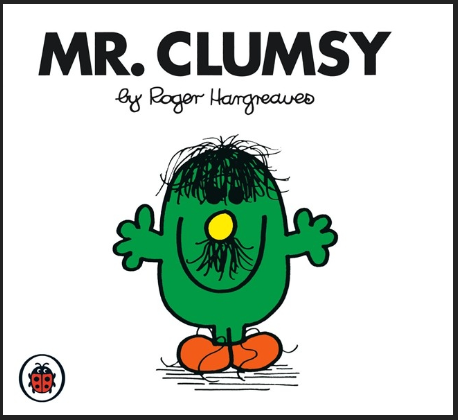
Mr Clumsy (and Mr Fussy)
by Roger Hargreaves


Dear Mr Hargreaves,

As a father of two small children, and as a former child myself, I have generally enjoyed your Mr Men series of books, notwithstanding the often unnecessarily verbose text, which makes some of them feel like novellas and inspires a sense of dread when I am asked to read three of them in succession before bedtime, and has led to my subconscious use of 79 words in this particular paragraph when 10 would clearly, obviously, and undoubtedly have sufficed.

However, that is neither here nor there. The reason for my letter is that I wish to complain about an unfair national stereotype perpetuated by your books.

From my repeated readings of the Mr Men canon, I have learnt that Mr Happy lives in Happyland, Mr Clever lives in Cleverland and Mr Nonsense lives in Nonsenseland. This makes sense, in the same way that Thais live in Thailand, Finns live in Finland and northern ire lives in Northern Ireland.

So, why does Mr Clumsy live in Australia?

That’s right, Mr Clumsy does not live in Clumsyland. He lives in Australia.

This, Mr Hargreaves, is nothing but offensive national stereotyping.  

You introduce Mr Clumsy as a dishevelled, long-lost cousin of Mr Fussy. This boorish Australian layabout lobs on Mr Fussy’s doorstep and asks to stay. He appears unable, or perhaps unwilling, to comb his hair, tie his shoelaces, or engage in any of the other basic functions expected in a civilised society. When he later stars in his own book, Mr Clumsy is so dense that he puts a letter from the postman in the toaster and tries to read a piece of bread.

Which brings me to another point. I understand the word ‘clumsy’ to mean ‘awkward’, or ‘ungainly’, but you apparently think it means ‘idiotic’. This character is effectively ‘Mr Stupid’, but you clearly realised that introducing Mr Stupid from Australia would be crossing the line, so you softened his name while retaining his moronic nature. Spilling your beer while dropping a catch during a game of backyard cricket is clumsy Australian behaviour; toasting an envelope is simply inane.

Please understand, Mr Hargreaves, that although we recently had a prime minister who tried to eat an onion like it was an apple, and a deputy prime minister who was unaware that he was a citizen of New Zealand, we are not all idiots. I will admit that two of the four members of my household are unable to tie their shoelaces, but this is because they are aged one and two respectively. The fact that they are Australian is purely coincidental.

Perhaps political correctness had not yet gone mad when you introduced Mr Clumsy in 1976, but since then it has become certifiable. As such, I request that when the series is next reprinted, Mr Clumsy should come from Clumsyland rather than Australia. At the very least he should hold dual citizenship, which admittedly would preclude him from running for Australian parliament, but in any case we have enough oafish behaviour in that institution without adding Mr Clumsy to the mix.

I have been told, Mr Hargreaves, that you died 30 years ago, and I therefore understand that you may face certain difficulties in replying to my letter. Nevertheless, I shall await a response via the late mail.

Yours sincerely,

Mr Offended


Monday, September 18, 2017

Wow! Said the Owl
by Tim Hopgood


Heidi’s favourite toy is a soft owl, and her favourite pastime is reading stories. So it should be no surprise that she has plenty of books about owls. There’s Owl Babies by Martin Waddell and Patrick Benson. There’s Ten Little Owls by Renee Treml. There’s The Owl and the Pussycat by Edward Lear, illustrated by Jan Brett. There’s Let’s Explore Diabetes with Owls by David Sedaris. Actually, how did that one get onto her shelf?

But by far her favourite owl book is Wow! Said the Owl by Tim Hopgood. In fact, if I told her she could only keep one of her hundreds of books and we would throw the rest out, I think she would pick Wow! Said the Owl to save. And then she’d cry and I would be a terrible parent. But my point is it’s probably her favourite book of all. Here’s a recent exchange that demonstrates just how much two-year-old Heidi loves this book.

Me: What does a sheep say?
Heidi: Baa-baa!

Me: What does a lion say?
Heidi: Rooooaar!

Me: What does an owl say?
Heidi: Wow!

Wow! Said the Owl is perfect for toddlers of Heidi’s age. A curious little owl stays awake during the daytime instead of going to sleep, and discovers all the vivid colours of the world around her. On each page she says “WOW!” as she sees a new colour – the warm pink sky, the yellow sun, the green leaves on her tree, the pretty red butterflies, the grey clouds when it starts to rain.

The day finishes with a rainbow, and then the little owl stays up all night, just like little owls are supposed to, and she decides that the night-time stars are the most beautiful of all. The final page, after the end of the story, shows a sort of colour wheel, and Heidi loves to point to each one and say the name of the colour – even if she calls both indigo and violet a generic “purple”. I mean, who ever uses the word “indigo” anyway?

I don’t know what it is about owls that Heidi loves so much. I guess the big eyes do make them look pretty cute. The big eyes also help owls to find the mice, voles and other small mammals and birds that they like to attack with their razor-sharp talons and eat. Not so cute now, are they? Maybe that’s what the famously mysterious Twin Peaks clue meant: “The owls are not what they seem”.

But back to Wow! Said the Owl. Sometimes Heidi likes reading stories on her own, and you can tell when she’s reading this one even if you're not in the room. You’ll just hear “wow” as she turns each page, then a lot of gobbledegook with the occasional name of a colour thrown in. When she gets to the page full of red butterflies, she says “owl?” – it’s the only page that doesn’t show the curious little owl.

I hadn’t heard of Tim Hopgood before we picked up a copy of this book. He has a background in graphic design and uses those skills in combination with his drawing ability to produce his works. He scans the various elements, including his drawings, into his computer and assembles the images digitally. All his work starts in black and white, and he colours it using his computer – this way he can test out different colour combinations.

Fascinatingly, he collects textures from unusual places – the clouds in Wow! Said the Owl have a pattern he scanned in from the inside of an envelope from his bank! What sort of creative mind comes up with that idea? Every time we read Wow! Said the Owl now – which is to say, several times a week – I’ll pay special attention to those patterned clouds and be reminded how a clever mind can see creative potential in the most mundane objects.

All of this creativity combines to be a cut above your usual toddler book. In fact, it has become so popular that in 2015 Wow! Said the Owl was adapted into a stage show using puppets in London, and received rave reviews.

Speaking of reviews, on the back cover of Wow! Said the Owl, you’ll see the following testimonial: “Just the right blend of vivid illustration and engaging text” – Daily Mail. For the first (and probably last) time in my life, I am forced to admit that the Daily Mail got something bang on.

Sunday, July 16, 2017

Dogger
by Shirley Hughes


Today, the iconic Shirley Hughes turns 90. And today DadReads goes out on a limb to declare that Shirley Hughes may well be the greatest living children’s author and illustrator in the world. I am open to counter-arguments, but for longevity in the industry and consistent quality of output, who else is even in the same league?

Eric Carle? He is now 88, and it is nearly fifty years since he produced The Very Hungry Caterpillar, one of the most universal childhood classics of all time. But some of his other works have been positively dull. Carle’s The Very Quiet Cricket is the slowest-moving cricket book since Test Cricket Lists.

Judith Kerr? At 94, she remains best known for the Mog series and The Tiger who Came to Tea. They are beloved books for some, but I’ve always found her work a little strange, and certainly lacking the warmth of Shirley Hughes.

From the Antipodes there is Pamela Allen, who is 83, but in my opinion falls into the same category as Judith Kerr – quirky, and a little cold. If I was voting for the finest Australian or New Zealander it would be Graeme Base or Dame Lynley Dodd.

It is worth noting that some living greats – Mem Fox and Allan Ahlberg, for example – are authors only, and thus do not qualify as author-illustrators. I could accept arguments for Raymond Briggs, who is a worthy candidate, or for Sir Quentin Blake, whose pictures are iconic, but whose writing I personally am yet to read.

But for me, it’s Shirley Hughes. Maybe I’m swayed by nostalgia, because the stories featuring Alfie and Annie-Rose, and Lucy and Tom, were such a big part of my childhood. Re-reading them now takes me back to a warm and fuzzy place, but it’s a warm and fuzzy place that I know is shared by countless others around the world.

In Britain, Hughes is something of a national treasure. Her first book as author and illustrator, Lucy and Tom’s Day, came out in 1960. In an interview with The Guardian last month, she said she was currently working on another Alfie story. That’s nearly 60 years of output. Baby Boomers might have grown up with Shirley Hughes and could still today be enjoying her new works; their grandchildren may be growing up with her now, and can share the classics with their grandparents and parents.

In the UK right now there is almost a Festival of Shirley – she was recently guest editor of BBC Radio 4’s Woman’s Hour, and interviews with her have been featuring in various newspapers – celebrating both her 90th birthday and the 40th anniversary of one of her most beloved books, Dogger (a hardback anniversary edition of Dogger was published last month).

And Dogger really is beloved. Not only did it win the Kate Greenaway Medal for “distinguished illustration in a book for children” in 1977, but when the Medal celebrated its 50th anniversary in 2007, Dogger was voted the best of the best, narrowly pipping another of my all-time favourites, Each Peach Pear Plum, to be named the finest winner in the Greenaway Medal’s history.

Dogger is the story of a little boy named Dave, his treasured soft toy dog, and his big sister Bella. One day, Dave loses Dogger while waiting with his mother to collect Bella from school, and a few days later, Dogger turns up for sale on the toy stall at the school fete. (As an aside, a huge percentage of Heidi’s books have come from school fetes – they are a goldmine of children’s books).

Dave doesn’t have the 3p he needs to buy Dogger back, and by the time he finds his big sister to help, another girl has bought Dogger. She refuses to sell him back to Dave, but Bella, who has just won a giant teddy bear in a three-legged race, comes to the rescue by trading her new teddy bear to the girl in return for Dogger. It is just the most beautiful moment of sibling love.

And this, I think, gets to the crux of why Shirley Hughes is so good. A memorable picture book might be funny (The Gruffalo), or intricate (Animalia), or whimsical (Hairy Maclary). Or, in the case of Dogger, it can be heartfelt. And heartfelt is deceptively difficult to achieve. The big risk is straying towards the saccharine (Guess How Much I Love You, for example, makes me want to vomit).

Shirley Hughes does heartfelt and warm with as much sincerity and skill as anyone. She has an incredible ability to empathise with children. Her stories are emotionally complex, just as little children are, and her illustrations are beautifully observed. She gets the small details right: the way Dave holds Dogger up to the school fence to show him the men setting up the fete, the subtly anxious look on Dave’s face as he tries to sleep without his beloved toy.

And she gets to the truth of how a child’s mind works, as when Bella wins her teddy bear:

"Dave didn’t like that teddy at all. At that moment he didn’t like Bella much either, because she kept on winning things."

I’m sure Dave still loved his sister, but at that moment he didn’t like her much. Kids, and especially those of toddler and pre-school age, are remarkably fickle, because they are still learning how to control their emotions. And with a two-year-old daughter, that is something that I am discovering more and more every day.

Perhaps Dogger resonates with me even more now because I’m a parent. I can just imagine the apprehension if Heidi’s favourite toy – an owl – was to go missing. And I can picture big sister Heidi looking after her little brother, Fletcher, in future years in just the way that Bella watches out for Dave.

If you don’t know Shirley Hughes and haven’t read her, you are missing out on a joyous experience. My other favourites as a child were Lucy and Tom’s Christmas, Alfie Gets in First, and An Evening At Alfie’s. I was introduced to Shirley Hughes by my Mum, who had first seen the books being read on Play School.

My Mum, Valerie, is a very talented illustrator herself – I would love to write a children’s book and have her illustrate it – and she loves Shirley Hughes now more than ever. In fact, I gave her Shirley’s autobiography for Mother’s Day this year, and I’m pleased to say it has sparked a renewed passion for the books. Now, my nearly 70-year-old Mum is actively compiling a library of Shirley Hughes books from secondhand shops and online. Here’s what Mum says about Shirley Hughes:

"Shirley Hughes is an observer. She sees the small details that we overlook. She can create a charming story from ordinary happenings, and her illustrations are full of colour and movement. I like these quotes from her book A Life Drawing.
'... to become a writer you must first become a reader, so becoming an illustrator is preceded by learning how to look.'
'Drawing means looking more intently and for longer than you do at any other time.'"
Shirley Hughes has been looking intently for 60 years. That’s why she’s the best there is.

Friday, March 24, 2017

Princess Smartypants
by Babette Cole


After Babette Cole died in January, The Guardian summed up her career rather well: “She created books on the kinds of disgusting topics that children love and adults mostly do not, and then, emboldened by their success, she went on to more controversial subjects, partly because she liked to shock and partly because she felt she had a duty to make sure children were properly informed.”

Her publisher summed her up even more succinctly: “She was as mad as a box of frogs”.

Her most famous book is probably Princess Smartypants, a reimagining of the traditional fairytale in which the helpless princess is whisked off her feet by her prince charming. But in Babette Cole’s version, the princess is a fiercely independent woman who is pressured by her parents, the king and the queen, into finding a man. Her attitude is clear from the first line of the book:

Princess Smartypants did not want to get married. She enjoyed being a Ms.

And so, to humour her parents, the princess sets various seemingly impossible tasks for her suitors. One by one they fail, until the princess is left alone in her castle to carry on happily on her own. But then Prince Swashubuckle turns up, unexpectedly completes all her various challenges, and thinks he has won her heart. Instead, her kiss turns him into a warty toad and the princess lives happily ever after. Prince Swashbuckle presumably gets turned off women forever – human ones, at least.

Not much about Princess Smartypants is subtle. It does not have a feminist undertone, rather a feminist monotone. The main character is spoilt, selfish and mean. Poor Prince Swashbuckle was only trying to be kind, and she turned him into a toad. And yet, is any of that a problem? Probably not. Sometimes a good bashing over the head is necessary to get the message across.

It is worth noting that this book was written in 1986; 25 years later Australia had a female prime minister who was castigated for being “deliberately barren”, and a further five years down the track the USA has a president who says of women “grab them by the pussy”. So, yeah, still a fair way to go on the whole equality thing.

What is most fascinating – though not surprising – is the way that much of Babette Cole’s work divides opinion. A sample of Goodreads reader reviews of Princess Smartypants gives you the idea:

"Not only is it funny and cute, it  teaches children that no matter what, they don't have to compromise their boundaries and they don't have to conform to society's expectations." (From a 5-star review)

"From the lowbrow names of "Prince Pelvis, Swimbladder, Boneshaker, Grovel etc. and the overall disrespectful, non-familial attitudes to the man-hating, lying, deal breaking princess this book was feminist rubbish from top to bottom." (From a 1-star review)

"...great sense of humor and a beautiful message about being yourself and standing up for what you believe is right." (From a 5-star revew)

"This book seems to be telling girls that they would be better off without a husband and family. Definitely not the message I want to share with my little girls." (From a 1-star review).

And this from a more measured 3-star review:

"Books like this and the Paper Bag Princess seem to reinforce the idea that, in order to be a feminist and be independent, (1) you have to be mean to men, because they are bad, and (2) you have to be alone. It seems the implication is that if the character did get married or even have male friends, she would automatically give up all her independence and become a mindless cooking-and-cleaning drone (or a mindless gown-wearing ball-attending drone)."

I should point out that all of these reviews were written by (or, at least, appear to have been written by) women. But if good art polarises opinion, the same is often true of good literature – and why not children’s literature, too?

Several of her other books similarly divide opinion, including Hair in Funny Places, which deals with puberty, and Mummy Laid an Egg, a book about the facts of life that features graphic illustrations of various adventurous sexual positions. Her work often dealt with serious issues in an absurd manner, and her cartoonish pictures only add to the effect.

One last note on Babette Cole, unrelated to this book. Although she was only 67 when she died in January, she was lucky to have lived that long. Two years ago she was nearly killed when she was trampled by a herd of cows. She suffered broken ribs, a fractured shoulder blade and lacerations all over her body. Her left ear was left hanging off and had to be stitched back on by a cosmetic surgeon.

But her final word in the aftermath of the ordeal rather summed up her ability to shock. How would she deal with cows now? "I'm going to eat a lot more steak!" she said.

Saturday, December 24, 2016

Mog's Christmas
by Judith Kerr


I admire Judith Kerr’s realism. This may seem a strange thing to say of the woman who in 1968 wrote The Tiger Who Came to Tea, in which a tiger rings the doorbell, is invited inside by a young girl and her mother, eats all the food, drinks all the beer and leaves, and then father comes home from work, sees the destruction and cheerily says no worries girls, let’s just go out for dinner. I guess even children’s books were on hallucinogens in the late ’60s.

But when it comes to domestic cats, Judith Kerr knows her stuff. Mog is stupid, forgetful, lazy, easily frightened, and selfish. Let me run through that checklist with our cat, Ruby. Tick, tick, tick, tick, tick. Mog is so realistic it’s a wonder we never see her licking her anus. Mog even dies in the final book in the series, written 22 years after the first – despite her flaws, I hope we have that long with Ruby.

And so this festive season, what better book for DadReads than Mog’s Christmas? When I was a kid, Mog’s Christmas was a fixture of the holiday season. It wasn’t my favourite Christmas book – that was Lucy and Tom’s Christmas by Shirley Hughes. Maybe I related to it less because we didn’t have a pet cat. But I still enjoyed it. Now, as a cat owner, Mog’s Christmas resonates.

It’s nearly Christmas in the Thomas household, and everybody is busy:


Mog doesn’t like strangers visiting, so she hides outside. Ruby doesn’t like strangers visiting; she usually squeezes herself under the coffee table and waits until the coast is clear. In fact, Ruby doesn’t like anyone getting right up in her face. As well as a cat owner, I’m a baby owner, and Heidi enjoyed Mog’s Christmas so much that she tried to “read” it to Ruby by shoving it in front of her face. Good intentions, but Ruby scarpered.

Suddenly she woke up. She saw something. It was a tree. It was a tree walking. Mog thought, “Trees don’t walk. Trees should stay in one place. Once trees start walking about anything might happen.” She ran up the side of the house in case the tree should come and get her. “Come down,” shouted the tree. “Come down, Mog!” “First it walks,” thought Mog, “and now it’s shouting at me. I do not like that tree at all.

Mog thinks that the Christmas tree is walking because Mr Thomas is carrying it towards the house. Are cats that stupid? The first Christmas we had Ruby, she was exactly the same when I brought our Christmas tree inside. She ran away and hid. But then she got used to the tree and spent the next month eating pine needles and throwing them back up. Spiky? Yes. Indigestible? Yes. But damn they taste good. I guess anything would, compared to her own anus.

To be fair to Ruby, Heidi also had Christmas tree "issues". When we collected it from the local Rotary Club a few weeks ago and shoved it in the car, Heidi was a blubbering mess. Mog only had to see a tree walking. Heidi had to share the back seat of the car with one. She didn’t handle it well. If trees shouldn't walk, they definitely shouldn't go cruising in a Volkswagen Polo.

Anyway, Mog retreats to the roof. It starts snowing, but Mog is stubborn, and won’t come down. She goes to sleep on top of the chimney and then as the snow melts underneath her, she plummets down through the soot and lands in the fireplace. Her timing is fortuitous; one page earlier, Mrs Thomas was stacking logs in the fireplace, preparing to light them. It was nearly roast cat for Christmas dinner.

When Mog lands in the living room, one of the senile aunts cries “It’s Father Christmas!” “No, dear,” says the other aunt. “Father Christmas does not have a tail.” This, I think, is evidence that the aunts are blood relatives of Mrs Thomas, who displayed a tenuous grasp on reality in Mog and the Baby.

All’s well that ends well, and Mog’s Christmas finishes with everyone standing around the Christmas tree unwrapping presents. At least, I hope that’s what’s happening, because one of the senile aunts is holding a pair of pantyhose. If she hasn’t just unwrapped them, she’s taken them off, and the daft smile on her face makes me wonder which it is.

Mog’s creator Judith Kerr, now 93, has had an interesting life. Her father Alfred Kempner (he later changed his name to Kerr) was a well-known German theatre critic nicknamed the Kulturpapst, or “Culture Pope”. Judith was born of Jewish origin in Germany in 1923, not an ideal time to be born of Jewish origin in Germany, and the family moved to Britain when she was 10.

As of last year, she was still publishing new works – Mog’s Christmas Calamity was the latest. I haven’t read it, but maybe the calamity was that the Thomases only just realised Mog had been dead for 13 years. Given Mrs Thomas’ absent-mindedness – in Mog and the Baby she lets a neighbour’s child escape the house and run into oncoming traffic – this would not be a surprise. If you told me Mrs Thomas had been feeding Mog’s corpse since 2002, I’d believe you.

On that bright note, Merry Christmas from DadReads.

Tuesday, November 15, 2016

Roger Hargreaves predicts the US presidents


The 43rd book in the Mr Men series was Mr Cheerful. The 43rd US president was that grinning idiot George W Bush.

The 44th book in the Mr Men series was Mr Cool. The 44th US president is Barack Obama.

The 45th book in the Mr Men series was Mr Rude. The 45th US president will be Donald Trump.

Look at this sequence and tell me the late Roger Hargreaves wasn't Nostradamus. (Well, along with his son Adam, who now writes the series).

Mr Rude is a weird shade of orangey-red. He insults everyone. He has a doormat, but has crossed out the word “WELCOME” and scribbled “GO AWAY”.

If he met someone overweight he would shout, “Fatty! You’re supposed to take the food out of the fridge, not eat the fridge as well!"

The good news is that by the end of the story, Mr Rude’s rage has eased, and Mr Happy has taught him manners. (Mr Happy is 3rd in the Mr Men series, so maybe Trump needs to spend some time at the Thomas Jefferson Memorial).

The even better news is that the 46th book in the Mr Men series is Mr Good.

So, Bernie Sanders for 2020?

Thursday, September 15, 2016

Dear Zoo
by Rod Campbell


In primary school we had books called Free Stuff for Kids, that listed heaps of things we could send away for in the post. You could get stickers, posters, stuff like that. I definitely do not recall an option to send away to the zoo for a pet.

It seems an irresponsible and expensive concept. You’d need a shitload of stamps to post an elephant to a kid. But that’s the basis of Dear Zoo, the classic lift-the-flap book by Scottish author and illustrator Rod Campbell.

“I wrote to the zoo to send me a pet,” a kid writes on the first page. If I was the zookeeper I’d have thought: “What’s the wee bairn havering aboot?” I assume that’s how Scottish people talk. Then I’d have written to young Angus or Morag or whoever and explained that zoo animals need special care and attention and are not appropriate as family pets.

Instead, this zoo sends the kid an elephant, which is about as responsible as putting Donald Trump in charge of the nuclear codes. And like Trump the kid is a whining jackass, complains that the elephant is too big, and sends it back. They send a giraffe. It’s too tall, the kid says, and sends it back.

Reading between the lines, I suspect the zookeeper becomes annoyed at this point. The kid gets sent a lion, and then a snake. What sort of zookeeper thinks these are appropriate pets for a child? A pissed-off zookeeper who wants to teach the ungrateful little shit a lesson, perhaps.

But the kid is not to be deterred, and keeps returning the animals until the zoo sends a cute puppy dog. “He was perfect! I kept him,” the kid says. What sort of puppies does a zoo keep? It'll probably grow up to be a wolf or a dingo or something. Next time write to the Lost Dogs’ Home, kid.

Dear Zoo is a classic that was first published in 1982. It’s cute, simple and interactive – Heidi loves lifting the flaps to see what animal is underneath. And for all my facetiousness, I think it’s a lot of fun.  

I’m just not sure about the moral of the story, which appears to be “keep whingeing until you get what you want”. Thanks, Rod. As if kids need any encouragement with that.

Thursday, May 12, 2016

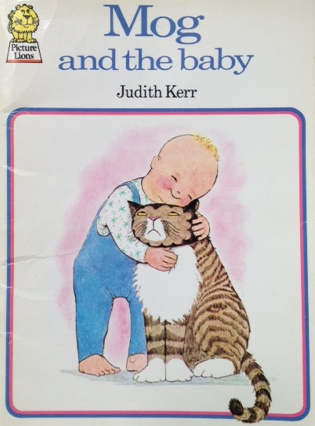
Mog and the Baby
by Judith Kerr


This is a story of woeful neglect and misplaced trust. It is a warning to new parents: be careful – be very careful – when choosing a babysitter. Because like the unfortunate Mrs Clutterbuck, you might come home to find your baby wandering on the road, in the path of oncoming traffic, without an adult in sight. Tonight’s bedtime story is Mog and the Baby, but a more apt title would be Mrs Clutterbuck and the Clusterfuck.

First, some background. This is the third book in the Mog series by Judith Kerr. When I was little I had Mog’s Christmas, and it was a favourite during the holiday season. Mog was depicted as quite the typical cat: grumpy, self-centred and always causing trouble. But the pictures were cute, and the story fun, and I loved Mog’s Christmas.

In Mog and the Baby, a young mother struggling to juggle the care of a baby and the running of a household wants a couple of hours to do some shopping. Is that so much to ask? So she leaves her baby with Mrs Thomas, presumably a neighbour, who owns a cat named Mog. Mrs Thomas has two kids, Debbie and Nicky, who have survived enough years to give Mrs Clutterbuck confidence in Mrs Thomas as a carer. But perhaps that was more luck than good management.

Truth be told, the warning signs are there when Mrs Clutterbuck drops the baby off. “We’re going to look after it while she goes shopping,” Mrs Thomas tells her son Nicky, who is skipping school with a cold. “It’s trying to say puss,” she says when the baby makes a noise towards Mog. Notice anything wrong with Mrs Thomas’ words?

She calls the baby “it”. Twice. In front of Mrs Clutterbuck. She doesn’t call it by name, doesn’t even say “he” or “she”. No, just “it”. Poor Mrs Clutterbuck, she does seem uncertain, taking her time to put on her coat and leave. “Will my baby be all right with your cat?” she asks. What she is really wondering is: “Will my baby be all right with you?”

And that would be a valid question. Let me run you through the events that follow. While Mrs Thomas and Nicky are doing the lunch dishes the baby, completely unsupervised, overturns Mog’s food bowl and starts eating the cat food. “Look what it’s done,” Nicky says when he realises. (It, again).

So then Mrs Thomas decides the easiest option is to lift the top off the pram, sit it on the floor and stick the baby in there, hoping it might sleep. Then she runs off to get Mog and puts the cat in its basket right next to the baby, like some sort of supervisor. Seriously lady, Mog is a cat. You’re the only human adult in this house. Take some responsibility.

But instead, she goes off to do other things (read a magazine? sink a glass or two of wine?) and the baby climbs out and pulls Mog’s tail. Mog cracks the shits and pushes open a window to escape, the baby follows, Mog runs across the road and the baby follows again. Still no sign of Mrs Thomas.

The baby finds itself in the path of an oncoming car being driven by Mr Thomas, with Mrs Clutterbuck as a passenger. Has she really just been shopping? Is there more to this than meets the eye? Is it possible Mrs Thomas was neglecting the baby out of jealousy? Anyway, whatever the case, Mog accidentally knocks the baby out of harm’s way and is the hero.

And then the crowning insult. While Mrs Clutterbuck clutches her baby in relief, young Nicky says: “It’s a silly baby. It shouldn’t have run into the road”. A classic case of victim-blaming.

“Mog saved it,” says Debbie. (It, again).

“She is a very brave cat,” says Nicky. (The cat gets called “she” but the baby is “it”. You can see where this family’s priorities lie).

The upshot is that Mog gets a reward, nobody questions what the hell Mrs Thomas was doing that she let a baby run out of her house and onto the road, and everyone lives happily ever after.

Except for Mrs Clutterbuck, who presumably goes home to have a nervous breakdown.

Friday, April 29, 2016

Mr Tickle
by Roger Hargreaves


Global franchises start innocuously enough. In Kentucky during the depression, Harland Sanders threw a few herbs and spices into some gas-station fried chicken. In Sweden during the war, a teenage Ingvar Kamprad saw his first bloody Allen key and the bloody flatpack was inflicted on the world.

And in England just after the end of the swinging sixties, six-year-old Adam Hargreaves asked his dad: “What does a tickle look like?”

His father, Roger, was the creative director at an advertising firm. If Mad Men has taught us anything, it’s that the Don Drapers of this world know all about slap and tickle. Here was the perfect excuse for Roger to go away and do some “research”.

But no, this was Roger Hargreaves, not Roger Sterling. He wasn’t like that. And nor was he an “ask your mother” kind of dad. He did indeed go off and indulge his passion, but it was a passion for drawing, and he came up with an answer to Adam’s question.

Mr Tickle. Orange body, long arms, blue hat. Incorrigible groper.

Roger Hargreaves realised that Mr Tickle opened all sorts of doors, and not just the kitchen door from his bedroom so he could raid the biscuit tin.

If ever there was a series waiting to happen it was this.

There was a simple formula for almost infinite ideas: Mr (insert characteristic here). Which was later expanded to add Little Miss (insert characteristic here).

Roger Hargreaves died in 1988, at the age of 53. Adam, by then in his 20s, eventually carried on the family business and wrote new books for the series.

And he’s done a good job. But I was a child of the 80s, so to me, the likes of Mr Cool and Mr Rude will always be impostors. Even the few of Roger’s own works published after his death – Mr Brave to Mr Cheerful – don’t sit well with me. Anything after Mr Slow, I consider non-canon.

In 1971, Mr Tickle was the first. He tickled the policeman without getting shot. He tickled the butcher without losing an arm. He hid outside a school window, reached into the classroom for a tickle, and did not face criminal charges.

And he tickled my fancy. Sure, he spent his days interfering with strangers, but he did it with a smile. They were more innocent times. 

Since then, there has been a TV series, special editions, merchandise, parodies. And it all began with Mr Tickle. He is the Mr who started a global franchise.