Showing posts with label Judith Kerr. Show all posts

Thursday, June 14, 2018

The Tiger Who Came to Tea
by Judith Kerr


Judith Kerr turns 95 today. At that age, when she blows out the candles she might simply wish for more birthdays. To be fair, that’s sensible regardless of age. But if I could borrow that wish, I would use it to have her tell me the secret of what this mysterious classic is about. I mean, what it’s really about. Fifty years after The Tiger Who Came to Tea was first published, Kerr still insists it is nothing deeper than the story of a tiger visiting a little girl named Sophie. Pull the other one, Judith.
 
The events begin innocently enough. Sophie and her mummy are enjoying some afternoon tea when the doorbell rings. Sophie’s mummy wonders if it could be the milkman or the boy from the grocer. In 2018, a man putting milk on my doorstep would alarm me nearly as much as a tiger asking to come in for tea, but in 1968 the tiger would have been the more shocking option. So you’d think. But Sophie and her mummy politely invite the tiger inside to share their meal.
 
The tiger gobbles up all the sandwiches, drinks all the tea from the teapot, scoffs all the buns, biscuits and cake on the table, then makes for the kitchen to eat the supper on the stove, all the food in the fridge, and everything in the pantry. Understandably thirsty, he drinks all the milk and orange juice, all of Daddy’s beer, and all the water in the tap. Think about how parched you’d have to be to drink all the water in the tap. Poor Sophie couldn’t even have a bath.
 
But to me, the crux of the story is when Sophie’s daddy comes home from work and listens to his wife explain why there is no supper on the table and, more importantly, where his beer has gone. He sits in his chair, patient, slightly worried, thousand-yard stare fixed firmly to his face. What is he thinking in that moment? Is he thinking, oh god, she’s really gone off the deep end this time? Or, nice try love, but I know exactly who drank my beer? Or, simply, here we go again?


Whatever the case, Sophie’s daddy handles the situation just as any self-respecting British man of his era would. Repression. Denial. Keep calm and carry on. He asks no hard questions, seeks no help for his clearly deranged wife and child. He merely suggests they have their supper at a cafĂ©. This is not the time for panic, but for sausages, chips and stiff upper lips.
 
The Tiger Who Came to Tea was Judith Kerr’s first book, published in the same year that her husband, well-known screenwriter Nigel Kneale, had his television play The Year of the Sex Olympics broadcast by the BBC. (Don’t be fooled by the title: it was a perceptive, dystopian work that anticipated reality TV decades ahead of time). Theirs was clearly an imaginative household. Kerr says she was unimpressed at the preachy picture books of the 1950s, so one day when she and her young daughter Tacy were bored at home and wishing someone would visit, she made up the story of a tiger coming to tea.
 
A few years later, when her children were at school, she finally had time to illustrate the story and have it published. Kerr says she has improved as an illustrator since then, but her clean, beautiful pictures capture not only the mood of the story, but also the fashions of the late 1960s. The tiger was still just a tiger, but Kerr’s own background has led to a persistent rumour that the creature represented something far more sinister: the Gestapo.
 
Kerr was born of a Jewish background in Germany in 1923 and her parents were friends of Albert Einstein – she once wrote that, at a party in Berlin, Einstein had explained his theory of relativity to her mother. Kerr’s father was a noted theatre critic who had also openly criticised the Nazi Party, and the family wisely fled to France in 1933, shortly before Adolf Hitler’s rise to power. Three years later, they moved further towards safety, settling in London.
 
But was there something from those early years in Germany that led to the tiger’s tale? Could he represent the Gestapo, the Nazi secret police who could come knocking on your door at any time? It is a rumour that Kerr has steadfastly denied, pointing to the way Sophie nuzzles in to the tiger to indicate that he is really no threat at all. “I don’t think one would snuggle the Gestapo, even subconsciously,” Kerr once said.
 
Personally, I had wondered if the tiger represented a dark, addictive, or even unbalanced side of Sophie’s own mummy. Remember, all of Sophie’s daddy’s beer disappeared during one weekday afternoon. Recently, the spotlight has started to shine on the “wine-mum” culture. Often celebrated in light-hearted, comical memes, it’s also an alarming reflection of the number of parents (of both sexes) literally being driven to drink by the demands and expectations of parenthood.
 
At least these days mental health issues (including post-natal depression) are more openly acknowledged and discussed than in the past. As a father, I feel incredibly lucky to spend a lot of time at home caring for my children, and I wouldn’t change it for the world. But it has its challenges, and I could empathise if Sophie’s mummy’s felt she needed to take the edge off her day. My daughter Heidi is about to turn three, and we have certainly experienced our fair share of the Terrible Twos. Worryingly, being a “Threenager” is also a thing, apparently.
 
Anyway, that's just my theory. As Kerr insists, perhaps the tiger is nothing more than a tiger, the antagonist in a fun, memorable story - and one that Heidi loves. She also loves the Mog stories, for which Judith Kerr is most famous. At 95, Kerr still works every day, has published more than 30 books, and has another one due out later this year. Not bad given that English was her third language. In fact, in 2013, Britain's first bilingual state school in English and German was named after her: the Judith Kerr Primary School in south London. The students will no doubt be celebrating today.

Saturday, December 24, 2016

Mog's Christmas
by Judith Kerr


I admire Judith Kerr’s realism. This may seem a strange thing to say of the woman who in 1968 wrote The Tiger Who Came to Tea, in which a tiger rings the doorbell, is invited inside by a young girl and her mother, eats all the food, drinks all the beer and leaves, and then father comes home from work, sees the destruction and cheerily says no worries girls, let’s just go out for dinner. I guess even children’s books were on hallucinogens in the late ’60s.

But when it comes to domestic cats, Judith Kerr knows her stuff. Mog is stupid, forgetful, lazy, easily frightened, and selfish. Let me run through that checklist with our cat, Ruby. Tick, tick, tick, tick, tick. Mog is so realistic it’s a wonder we never see her licking her anus. Mog even dies in the final book in the series, written 22 years after the first – despite her flaws, I hope we have that long with Ruby.

And so this festive season, what better book for DadReads than Mog’s Christmas? When I was a kid, Mog’s Christmas was a fixture of the holiday season. It wasn’t my favourite Christmas book – that was Lucy and Tom’s Christmas by Shirley Hughes. Maybe I related to it less because we didn’t have a pet cat. But I still enjoyed it. Now, as a cat owner, Mog’s Christmas resonates.

It’s nearly Christmas in the Thomas household, and everybody is busy:


Mog doesn’t like strangers visiting, so she hides outside. Ruby doesn’t like strangers visiting; she usually squeezes herself under the coffee table and waits until the coast is clear. In fact, Ruby doesn’t like anyone getting right up in her face. As well as a cat owner, I’m a baby owner, and Heidi enjoyed Mog’s Christmas so much that she tried to “read” it to Ruby by shoving it in front of her face. Good intentions, but Ruby scarpered.

Suddenly she woke up. She saw something. It was a tree. It was a tree walking. Mog thought, “Trees don’t walk. Trees should stay in one place. Once trees start walking about anything might happen.” She ran up the side of the house in case the tree should come and get her. “Come down,” shouted the tree. “Come down, Mog!” “First it walks,” thought Mog, “and now it’s shouting at me. I do not like that tree at all.

Mog thinks that the Christmas tree is walking because Mr Thomas is carrying it towards the house. Are cats that stupid? The first Christmas we had Ruby, she was exactly the same when I brought our Christmas tree inside. She ran away and hid. But then she got used to the tree and spent the next month eating pine needles and throwing them back up. Spiky? Yes. Indigestible? Yes. But damn they taste good. I guess anything would, compared to her own anus.

To be fair to Ruby, Heidi also had Christmas tree "issues". When we collected it from the local Rotary Club a few weeks ago and shoved it in the car, Heidi was a blubbering mess. Mog only had to see a tree walking. Heidi had to share the back seat of the car with one. She didn’t handle it well. If trees shouldn't walk, they definitely shouldn't go cruising in a Volkswagen Polo.

Anyway, Mog retreats to the roof. It starts snowing, but Mog is stubborn, and won’t come down. She goes to sleep on top of the chimney and then as the snow melts underneath her, she plummets down through the soot and lands in the fireplace. Her timing is fortuitous; one page earlier, Mrs Thomas was stacking logs in the fireplace, preparing to light them. It was nearly roast cat for Christmas dinner.

When Mog lands in the living room, one of the senile aunts cries “It’s Father Christmas!” “No, dear,” says the other aunt. “Father Christmas does not have a tail.” This, I think, is evidence that the aunts are blood relatives of Mrs Thomas, who displayed a tenuous grasp on reality in Mog and the Baby.

All’s well that ends well, and Mog’s Christmas finishes with everyone standing around the Christmas tree unwrapping presents. At least, I hope that’s what’s happening, because one of the senile aunts is holding a pair of pantyhose. If she hasn’t just unwrapped them, she’s taken them off, and the daft smile on her face makes me wonder which it is.

Mog’s creator Judith Kerr, now 93, has had an interesting life. Her father Alfred Kempner (he later changed his name to Kerr) was a well-known German theatre critic nicknamed the Kulturpapst, or “Culture Pope”. Judith was born of Jewish origin in Germany in 1923, not an ideal time to be born of Jewish origin in Germany, and the family moved to Britain when she was 10.

As of last year, she was still publishing new works – Mog’s Christmas Calamity was the latest. I haven’t read it, but maybe the calamity was that the Thomases only just realised Mog had been dead for 13 years. Given Mrs Thomas’ absent-mindedness – in Mog and the Baby she lets a neighbour’s child escape the house and run into oncoming traffic – this would not be a surprise. If you told me Mrs Thomas had been feeding Mog’s corpse since 2002, I’d believe you.

On that bright note, Merry Christmas from DadReads.

Thursday, May 12, 2016

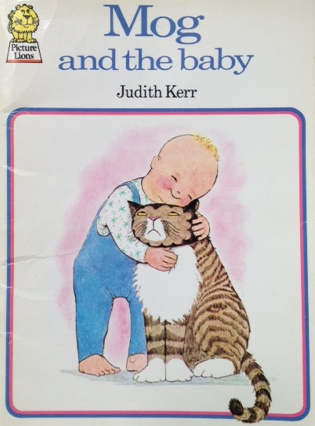
Mog and the Baby
by Judith Kerr


This is a story of woeful neglect and misplaced trust. It is a warning to new parents: be careful – be very careful – when choosing a babysitter. Because like the unfortunate Mrs Clutterbuck, you might come home to find your baby wandering on the road, in the path of oncoming traffic, without an adult in sight. Tonight’s bedtime story is Mog and the Baby, but a more apt title would be Mrs Clutterbuck and the Clusterfuck.

First, some background. This is the third book in the Mog series by Judith Kerr. When I was little I had Mog’s Christmas, and it was a favourite during the holiday season. Mog was depicted as quite the typical cat: grumpy, self-centred and always causing trouble. But the pictures were cute, and the story fun, and I loved Mog’s Christmas.

In Mog and the Baby, a young mother struggling to juggle the care of a baby and the running of a household wants a couple of hours to do some shopping. Is that so much to ask? So she leaves her baby with Mrs Thomas, presumably a neighbour, who owns a cat named Mog. Mrs Thomas has two kids, Debbie and Nicky, who have survived enough years to give Mrs Clutterbuck confidence in Mrs Thomas as a carer. But perhaps that was more luck than good management.

Truth be told, the warning signs are there when Mrs Clutterbuck drops the baby off. “We’re going to look after it while she goes shopping,” Mrs Thomas tells her son Nicky, who is skipping school with a cold. “It’s trying to say puss,” she says when the baby makes a noise towards Mog. Notice anything wrong with Mrs Thomas’ words?

She calls the baby “it”. Twice. In front of Mrs Clutterbuck. She doesn’t call it by name, doesn’t even say “he” or “she”. No, just “it”. Poor Mrs Clutterbuck, she does seem uncertain, taking her time to put on her coat and leave. “Will my baby be all right with your cat?” she asks. What she is really wondering is: “Will my baby be all right with you?”

And that would be a valid question. Let me run you through the events that follow. While Mrs Thomas and Nicky are doing the lunch dishes the baby, completely unsupervised, overturns Mog’s food bowl and starts eating the cat food. “Look what it’s done,” Nicky says when he realises. (It, again).

So then Mrs Thomas decides the easiest option is to lift the top off the pram, sit it on the floor and stick the baby in there, hoping it might sleep. Then she runs off to get Mog and puts the cat in its basket right next to the baby, like some sort of supervisor. Seriously lady, Mog is a cat. You’re the only human adult in this house. Take some responsibility.

But instead, she goes off to do other things (read a magazine? sink a glass or two of wine?) and the baby climbs out and pulls Mog’s tail. Mog cracks the shits and pushes open a window to escape, the baby follows, Mog runs across the road and the baby follows again. Still no sign of Mrs Thomas.

The baby finds itself in the path of an oncoming car being driven by Mr Thomas, with Mrs Clutterbuck as a passenger. Has she really just been shopping? Is there more to this than meets the eye? Is it possible Mrs Thomas was neglecting the baby out of jealousy? Anyway, whatever the case, Mog accidentally knocks the baby out of harm’s way and is the hero.

And then the crowning insult. While Mrs Clutterbuck clutches her baby in relief, young Nicky says: “It’s a silly baby. It shouldn’t have run into the road”. A classic case of victim-blaming.

“Mog saved it,” says Debbie. (It, again).

“She is a very brave cat,” says Nicky. (The cat gets called “she” but the baby is “it”. You can see where this family’s priorities lie).

The upshot is that Mog gets a reward, nobody questions what the hell Mrs Thomas was doing that she let a baby run out of her house and onto the road, and everyone lives happily ever after.

Except for Mrs Clutterbuck, who presumably goes home to have a nervous breakdown.