Thursday, June 30, 2016

Goodnight Moon
by Margaret Wise Brown


Next year, Goodnight Moon turns 70 years old. It has sold more than 14 million copies since it was first published in 1947 and is one of the most beloved bedtime stories of all. And yet, until recently I had never read it. I’m not even sure I had heard of it until I saw it on Heidi’s shelf, a baby-shower gift that I hadn’t noticed before.

So we read it. And I thought: “What the hell was that all about?”

There was something vaguely unsettling in the pages, haunting even. The stark red and green colour scheme, the vast room, the single red balloon hovering in the corner, the “quiet old lady” who is actually a rabbit and who is sometimes there and sometimes not. It was all a bit ... eerie.

In the great green room, a little rabbit lies in bed saying goodnight to everything he can see. And some things he can’t. Goodnight comb. Goodnight chairs. Goodnight mush. Goodnight nobody. Goodnight air. Goodnight air? That’s a kid desperately trying to drag out his bedtime.

All I could think of was Steve Carell as Brick the weatherman in Anchorman. I love ... carpet. I love ... desk. Brick, are you just looking at things in the office and saying that you love them? I love lamp. Do you really love the lamp or are you just saying it because you saw it? I love lamp. I love lamp.

I later read that George W. Bush nominated Goodnight Moon as one of his favourite books. And again I thought of Brick.

Anyway, back to the book. I wasn’t the only one who found it creepy. Zoe felt there was something Twin Peaks-ish about it. “What is the bowl full of mush?" she asked. “Is it porridge? Is it soup? Is it laced with LSD?”

I thought that a single reading nearly 70 years after publication was perhaps not the fairest way to assess Goodnight Moon, so I did some research. The author, Margaret Wise Brown, was interviewed by LIFE magazine the year before Goodnight Moon was published:
The first draft of a Brown book is usually written in wild, enthusiastic haste, in lost unintelligible soft pencil on whatever scraps of paper are available; the backs of grocery bills, shopping lists, old envelopes. “I finish the rough draft in 20 minutes,” Miss Brown says, “and then I spend two years polishing." She is currently polishing 23 books more or less simultaneously.
Brown only wrote, she did not illustrate, so the artwork fell to her friend and collaborator Clement Hurd. And there are some curious aspects to the illustrations, not the least of which is that the characters are rabbits. Apparently this was simply because Hurd was better at drawing bunnies than people.

Brown might have polished her words but you know what they say, you can’t polish a Hurd.

There are peculiar details if you look closely. On the bunny’s bedside table is a book with a green cover. Turn the page upside down and you’ll see it is a copy of Goodnight Moon. It is no surprise to find such a touch of absurdity.

One of the strangest pictorial elements is in the framed illustration over the fireplace in the little bunny’s room. It depicts a cow jumping over the moon, but the cow’s udder is hard to make out. In the words of Brown’s biographer, on the publisher’s instructions the udder “was reduced to an anatomical blur, so as not to disarrange the fragile sensibilities of some librarians”.

I can just imagine the library detective Mr Bookman, perhaps my all-time favourite Seinfeld guest character, enforcing that himself. “This is about that kid’s right to read a book without getting his mind warped. Or maybe that turns you on, Seinfeld, maybe that’s how you get your kicks.”

The mysterious blurred udder didn’t help. When it was first published, the New York Public Library refused to stock even a single copy of Goodnight Moon. It considered the book “unbearably sentimental” and did not acquire its first copy until 26 years later.

Children’s books, the library believed, should be fairytales or folklore, classics rather than the absurd modernity of Goodnight Moon. But Brown was ahead of her time. She had studied at an education college whose founder wanted to create a new style of picture story books, called “Here and Now”. At its core would be the everyday experiences of a regular toddler.

And that’s what kids respond to with Goodnight Moon. The bedroom is a place they know. The objects are familiar, although less so 70 years later. None would now recognise the old style telephone on the bedside table. Then again, why does a toddler need a phone by the bed anyway?

The concept of saying goodnight to random stuff, baffling as I found it on first reading, is actually quite sweet. Heidi is forever waving at anyone and anything, animate or inanimate. Even the blank “goodnight nobody” page seems true to life. Kids do say the darnedest things. The author gets inside the mind of a tiny child and uses soothing rhyme and rhythm to great effect.

To adults, the room seems abnormally vast. But Goodnight Moon wasn't written for adults. To a toddler, any room seems enormous. Their world is so small, their perspective so different from their parents. On a second and third reading, I realised that everything I found strange made much more sense from the little bunny's viewpoint.

As the pages progress and the bunny gets more tired, the illustrations become just a touch hazier. The final line – “goodnight noises everywhere” – acknowledges that bedtime for the little ones is early, while the rest of the house remains active.

Margaret Brown was perhaps more Wise than I first gave her credit for.

Then again, she died aged 42 when, after emergency surgery for appendicitis while on a publicity tour in France, she kicked up her legs, cancan style, to show how fit she felt. That dislodged a blood clot in her leg, which quickly travelled to her brain and killed her instantly.

Not so Wise after all. 

Friday, May 20, 2016

A Fish Out of Water
by Helen Palmer


When I was a kid, I always liked reading the “About the Author” blurb at the end of a book – probably the budding quizzer in me wanted every piece of available information. One of my favourite childhood books was A Fish Out of Water and my version had no such blurb – or if it did it was on a long-lost dust-jacket. So I’ve written one myself:
Helen Palmer was born in New York in 1898. For 40 years she was married to Dr Seuss. They had no children – Helen was unable to. In later years she suffered from cancer and partial paralysis. For the last few years of Helen’s life, Dr Seuss was having an affair with the woman who would later become his second wife. In 1967 an ill, depressed and heartbroken Helen committed suicide by an overdose of barbiturates.
Maybe there was a reason there was no such blurb.

We’ll get to A Fish Out of Water shortly, but first a little more on Helen Palmer. In 1927, Helen married Theodore Geisel, known to friends as Ted, and later known to the world as Dr Seuss. Ted Geisel wanted to become a teacher but Helen, six years his senior, encouraged him to make a career from his artwork. She was his editor, advisor, business manager and inspiration. She co-founded the “Beginner Books” imprint - you’d recognise the Cat in the Hat logo – in 1957.

And yet, a decade later Helen was dead. Within a year of her suicide Dr Seuss remarried. His second wife, Audrey, is still alive and in her mid-90s continues to serve as president of Dr Seuss Enterprises. There seems little doubt that the younger Audrey provided a renewed inspiration for Dr Seuss, who was 64 when he married for the second time. His niece Peggy described Helen’s death as “her last and greatest gift to him”. Her suicide note speaks for itself:
"Dear Ted, What has happened to us? I don't know. I feel myself in a spiral, going down down down, into a black hole from which there is no escape, no brightness. And loud in my ears from every side I hear, 'failure, failure, failure...' I love you so much ... I am too old and enmeshed in everything you do and are, that I cannot conceive of life without you ... My going will leave quite a rumor but you can say I was overworked and overwrought. Your reputation with your friends and fans will not be harmed ... Sometimes think of the fun we had all thru the years ..."
She might have heard “failure, failure, failure” from every side, but few people have given the world more joy than Helen Palmer. She gave the world Dr Seuss. But for her prodding, he might never have gone beyond the cartoons he drew as a college student. And Helen Palmer’s name also lives on as an author herself.

But even there she remains in her husband’s giant shadow, for A Fish Out of Water in fact originated as a short story by Dr Seuss, titled Gustav the Goldfish. It was originally published in a magazine in 1950, with the trademark Seuss rhymes and illustrations. You can see a comparison here. A decade later, he gave Helen permission to revise the story to make it a suitable “Beginner Book”, which required a more basic vocabulary.

In hindsight, the absurd premise is pure Seuss. A boy buys a pet goldfish and, against the advice of the pet-store owner, overfeeds it. The fish quickly outgrows every vessel in which the boy tries to house it, until even the local swimming pool is becoming too small to hold it. At this point the pet-store owner, Mr Carp, dives with a mysterious toolbox and magically returns the fish to its original size.

The illustrations by P. D. Eastman – a protégé of Dr Seuss – bring a charming realism to the preposterous story. Eastman’s drawings are much truer to life than the zany art of Dr Seuss, and something about the realistic looking figures – the baffled policeman and the concerned fireman – make it easy for a child to put themselves in the position of the little boy, to think maybe this really could happen!

I had never heard of Gustav the Goldfish until researching this blog, and I don’t know if I’d have preferred the Seussian version as a kid or A Fish Out of Water. They each appeal in different ways. All I can say with certainty is that I loved A Fish Out of Water and that Helen Palmer, despite her tragic end, was no failure.

Thursday, May 12, 2016

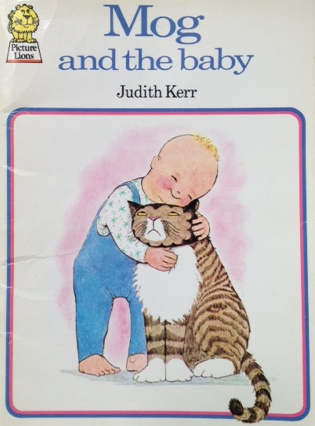
Mog and the Baby
by Judith Kerr


This is a story of woeful neglect and misplaced trust. It is a warning to new parents: be careful – be very careful – when choosing a babysitter. Because like the unfortunate Mrs Clutterbuck, you might come home to find your baby wandering on the road, in the path of oncoming traffic, without an adult in sight. Tonight’s bedtime story is Mog and the Baby, but a more apt title would be Mrs Clutterbuck and the Clusterfuck.

First, some background. This is the third book in the Mog series by Judith Kerr. When I was little I had Mog’s Christmas, and it was a favourite during the holiday season. Mog was depicted as quite the typical cat: grumpy, self-centred and always causing trouble. But the pictures were cute, and the story fun, and I loved Mog’s Christmas.

In Mog and the Baby, a young mother struggling to juggle the care of a baby and the running of a household wants a couple of hours to do some shopping. Is that so much to ask? So she leaves her baby with Mrs Thomas, presumably a neighbour, who owns a cat named Mog. Mrs Thomas has two kids, Debbie and Nicky, who have survived enough years to give Mrs Clutterbuck confidence in Mrs Thomas as a carer. But perhaps that was more luck than good management.

Truth be told, the warning signs are there when Mrs Clutterbuck drops the baby off. “We’re going to look after it while she goes shopping,” Mrs Thomas tells her son Nicky, who is skipping school with a cold. “It’s trying to say puss,” she says when the baby makes a noise towards Mog. Notice anything wrong with Mrs Thomas’ words?

She calls the baby “it”. Twice. In front of Mrs Clutterbuck. She doesn’t call it by name, doesn’t even say “he” or “she”. No, just “it”. Poor Mrs Clutterbuck, she does seem uncertain, taking her time to put on her coat and leave. “Will my baby be all right with your cat?” she asks. What she is really wondering is: “Will my baby be all right with you?”

And that would be a valid question. Let me run you through the events that follow. While Mrs Thomas and Nicky are doing the lunch dishes the baby, completely unsupervised, overturns Mog’s food bowl and starts eating the cat food. “Look what it’s done,” Nicky says when he realises. (It, again).

So then Mrs Thomas decides the easiest option is to lift the top off the pram, sit it on the floor and stick the baby in there, hoping it might sleep. Then she runs off to get Mog and puts the cat in its basket right next to the baby, like some sort of supervisor. Seriously lady, Mog is a cat. You’re the only human adult in this house. Take some responsibility.

But instead, she goes off to do other things (read a magazine? sink a glass or two of wine?) and the baby climbs out and pulls Mog’s tail. Mog cracks the shits and pushes open a window to escape, the baby follows, Mog runs across the road and the baby follows again. Still no sign of Mrs Thomas.

The baby finds itself in the path of an oncoming car being driven by Mr Thomas, with Mrs Clutterbuck as a passenger. Has she really just been shopping? Is there more to this than meets the eye? Is it possible Mrs Thomas was neglecting the baby out of jealousy? Anyway, whatever the case, Mog accidentally knocks the baby out of harm’s way and is the hero.

And then the crowning insult. While Mrs Clutterbuck clutches her baby in relief, young Nicky says: “It’s a silly baby. It shouldn’t have run into the road”. A classic case of victim-blaming.

“Mog saved it,” says Debbie. (It, again).

“She is a very brave cat,” says Nicky. (The cat gets called “she” but the baby is “it”. You can see where this family’s priorities lie).

The upshot is that Mog gets a reward, nobody questions what the hell Mrs Thomas was doing that she let a baby run out of her house and onto the road, and everyone lives happily ever after.

Except for Mrs Clutterbuck, who presumably goes home to have a nervous breakdown.

Thursday, May 5, 2016

Hairy Maclary from Donaldson's Dairy
by Lynley Dodd


I felt a natural affinity for Hairy Maclary when I was little. He was from Donaldson’s Dairy, I was from Coverdale’s Dairy. He was small and a bit scruffy. So was I. All he shared in common with his mates was location and species, but that was all they needed. Much like me and my primary school friends.

But I recently discovered something alarming about Hairy Maclary, something that I never would have suspected when I was a kid. We were from completely different kinds of dairy. Mine was a farm where cows were milked. His was a little shop that sells ice-creams and newspapers and bread and cans of baked beans that look like they’ve been there since the 1960s.

Did you know that? If you’re a Kiwi, you’re probably thinking: “Of course we did, you idiot”.

Because in New Zealand that’s what a dairy is – the kind of corner store Australians would call a milk bar. I learnt that a few years ago. And Hairy Maclary is a New Zealander. I learnt that in recent years too. Until now, though, I never put those two pieces of information together. I thought Hairy was a farm dog, like the one in Footrot Flats. Turns out he’s as much a farm dog as Brian Griffin.

Hairy’s creator, Lynley Dodd, confirmed it in 2014 in an interview with Fairfax. Or, to use her full title, Dame Lynley Dodd. So well-loved is the Hairy Maclary series that Lynley received a damehood in 2001.

There are currently only 52 dames in the New Zealand honours system, among them a former prime minister (Jenny Shipley), a former governor-general (Silvia Cartwright) and an Oscar-nominee (Jane Campion). For a children’s author and illustrator to be in such elite company is a serious honour.

But then, Hairy Maclary is a classic, so much so that it was the first bedtime story I ever read to baby Heidi. Not much happens plot-wise. Hairy and his friends go for a wander around town and run into Scarface Claw, the toughest tom in town. Then they all scamper home with their tails between their legs, literally.

So why is Hairy Maclary so enjoyable? In part it’s the pictures, the variety of the dogs, each adorable in their own way. But mostly it’s the rhymes and their easy rhythm, the fun of reading through the names of Hairy’s gang. Hercules Morse, as big as a horse. Muffin McLay, like a bundle of hay. Bottomley Potts, all covered in spots. Theophilus Tutts, who loves sniffing butts. Okay, I made that one up.

My favourite was always Schnitzel von Krumm, with a very low tum. And all these years later, the one I forgot about was Bitzer Maloney, all skinny and bony. Poor old Bitzer, I imagine he was always getting forgotten about. If you told me one of the gang would end up at the pound, I’d have Bitzer the skinny whippet a $1.25 favourite.

But the scruffy little star of this classic story, and the series that followed, is Hairy Maclary from Donaldson’s Dairy Milk Bar.

Friday, April 29, 2016

Mr Tickle
by Roger Hargreaves


Global franchises start innocuously enough. In Kentucky during the depression, Harland Sanders threw a few herbs and spices into some gas-station fried chicken. In Sweden during the war, a teenage Ingvar Kamprad saw his first bloody Allen key and the bloody flatpack was inflicted on the world.

And in England just after the end of the swinging sixties, six-year-old Adam Hargreaves asked his dad: “What does a tickle look like?”

His father, Roger, was the creative director at an advertising firm. If Mad Men has taught us anything, it’s that the Don Drapers of this world know all about slap and tickle. Here was the perfect excuse for Roger to go away and do some “research”.

But no, this was Roger Hargreaves, not Roger Sterling. He wasn’t like that. And nor was he an “ask your mother” kind of dad. He did indeed go off and indulge his passion, but it was a passion for drawing, and he came up with an answer to Adam’s question.

Mr Tickle. Orange body, long arms, blue hat. Incorrigible groper.

Roger Hargreaves realised that Mr Tickle opened all sorts of doors, and not just the kitchen door from his bedroom so he could raid the biscuit tin.

If ever there was a series waiting to happen it was this.

There was a simple formula for almost infinite ideas: Mr (insert characteristic here). Which was later expanded to add Little Miss (insert characteristic here).

Roger Hargreaves died in 1988, at the age of 53. Adam, by then in his 20s, eventually carried on the family business and wrote new books for the series.

And he’s done a good job. But I was a child of the 80s, so to me, the likes of Mr Cool and Mr Rude will always be impostors. Even the few of Roger’s own works published after his death – Mr Brave to Mr Cheerful – don’t sit well with me. Anything after Mr Slow, I consider non-canon.

In 1971, Mr Tickle was the first. He tickled the policeman without getting shot. He tickled the butcher without losing an arm. He hid outside a school window, reached into the classroom for a tickle, and did not face criminal charges.

And he tickled my fancy. Sure, he spent his days interfering with strangers, but he did it with a smile. They were more innocent times. 

Since then, there has been a TV series, special editions, merchandise, parodies. And it all began with Mr Tickle. He is the Mr who started a global franchise.

Saturday, April 23, 2016

Share Said the Rooster
by Pamela Allen


I remember the 1980s. Back before libraries used computers, back when borrowing cards still existed, when our primary school librarian Miss Hyde would stamp the due date inside the back cover.

Back when a story about a naked man sharing his bath with a goat, a wombat and a kangaroo rang no alarm bells.

The book in question, Mr Archimedes’ Bath, is a children’s classic in Australia. I remember liking it when I was little. But with the benefit of hindsight, it’s also ... a bit weird.

So it was with interest that I chose a newer book by the same author, Pamela Allen, for tonight’s bedtime story: Share Said the Rooster.

This is a story with a moral. Billy and Ben are the two characters who throughout the narrative refuse to share, despite the refrain of “Share said the rooster, share said the hen”.

They won’t share a pink sticky bun, they won’t share boots painted blue, they won’t share an apple up a tree, they won’t share an umbrella.

Their final problem is whether to share a boat out on the water. Aha, you think. Here comes the lesson. They’ll both get in the boat, the kiddies will learn the importance of sharing, and everyone will live happily ever after.

But no. Pamela Allen has other ideas.

She kills them.

Billy and Ben refuse to share the boat, and on the last page are shown sinking towards the bottom of the sea, presumably to their cold, watery graves.

The last line is chilling. “Goodbye Billy. Goodbye Ben.”

I did not see that coming. It was a twist worthy of Agatha Christie. In fact, I’ve read crime novels that have disturbed me less than this did.

It feels like a dark sequel to another Pamela Allen classic, Who Sank the Boat? At least in that one, everyone walks away unharmed.

This is a harsh lesson for kids to learn. Share Said the Rooster. OR ELSE YOU’LL DIE.

Sunday, April 17, 2016

There's a Wocket in My Pocket!
by Dr Seuss


Did you ever have the feeling there’s a WASKET in your BASKET? Did you ever get the feeling that the DOC had WRITER’S BLOCK? 

Dr Seuss was a favourite of mine when I was little. The Cat in the Hat. Classic. Fox in Socks. Great fun. But he was also incredibly prolific, writing more than 60 children’s books. Only now do I realise how few of them I’ve actually read.

So tonight’s bedtime story is a Dr Seuss work that is new to me: There’s a Wocket in My Pocket.

This was written in 1974, when the Doc was 70 years old and firmly established as a legend of children’s literature. Arguably the biggest name in the genre.

And so he said to himself: “Fuck it, I’m Dr Seuss, I can rhyme any old shit and people will buy it.”

That's about the only explanation for the lack of effort that went into There’s a Wocket in My Pocket.

This was Dr Seuss bereft of ideas, phoning it in. You can just picture him sitting at his desk, on deadline, looking around his house in desperation. What rhymes with bureau? Nothing. What rhymes with toothbrush? Nothing. What rhymes with chimney? Nothing.

Damn, I’d better make some words up.

There’s a ... nureau in my bureau. Yeah, that’ll do. And a ... nooth grush on my toothbrush. Not my best work, but hey, I wrote The Cat in the Hat. What are they gonna say? A quimney up the chimney. Hey, this is easy.

It seems appropriate this book was first published by Random House.

Some Dr Seuss works had important moral lessons, some were great vocabulary builders, others were just a lot of fun. And some, like this, were utter gibberish. Still, I suppose there is a hidden message. Don’t rest on your laurels.

Tuesday, April 5, 2016

Welcome to DadReads


Once upon a time, there was a little boy who loved his bedtime stories. His were the unquestioning eyes of a child. The stories sparked his imagination and showed him a world he was yet to discover. Some stories filled his mind with wonder.

Then he grew up. He became a father.

Now there was a little girl who loved her bedtime stories. So did her Dad. But his were the eyes of an adult. The stories sparked a sense of nostalgia, reminded him that the world once felt so vast and unknown. His wonder remained, but had evolved.

I wonder where the author got that idea? And who is this author anyway? How did this get published? How did I not notice that when I was a kid? Why is this considered a classic? Or, how is this not considered a classic?

Welcome to DadReads.